
Every B2B Service Provider Must Win Two Sales in 2027. Is Your Website Ready for Both?

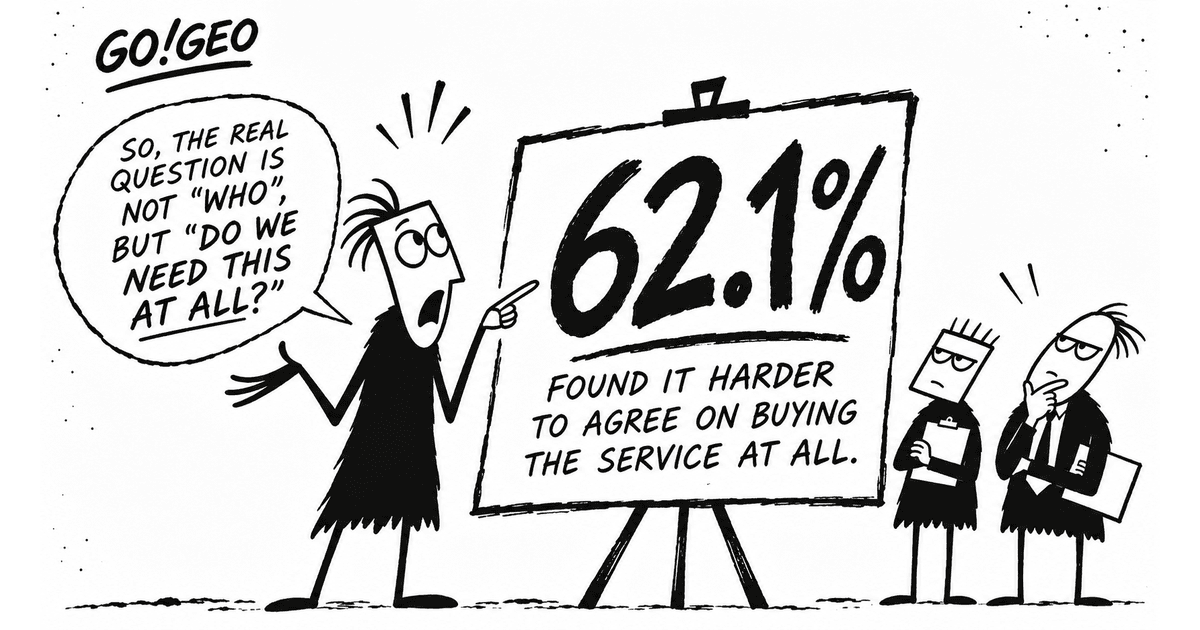
You can lose a B2B customer without even speaking to them.
Sometimes the buyer doesn't choose a competitor. The company simply decides not to purchase the service at all.
The 2026 B2B Buyer Experience Report by 6sense, published earlier this week, examines more than 4,600 B2B buying journeys across North America, Europe and Asia-Pacific. The researchers describe it as their most ambitious study yet.
One finding stands out: 62.1% of B2B services buyers said that agreeing internally on the value of investing in a service category was harder than choosing a supplier.
That creates two distinct sales. First: Why invest in this kind of service? Then: Why choose your company?
A prospect can know your business, respect your experience and still leave the budget unapproved. For B2B service providers, being the preferred supplier is valuable. Making the investment worth approving comes first.
The sale before the sale: make the investment worthwhile
Picture a company considering external cybersecurity advice, a recruitment partner or a new customer acquisition channel. The department head sees an opportunity. Finance wants evidence of financial value. The CEO wants to know why the budget should go here rather than somewhere else. All three could agree that a particular supplier is excellent - and still disagree about buying the service.
Across the categories studied by 6sense, 56.4% found internal agreement on category value harder than vendor selection. Among buyers acquiring a new capability, that figure rose to 61.5%, compared with 44.6% among those upgrading or replacing an existing capability.
This helps explain why a new service category such as Generative Engine Optimization (GEO) needs a business explanation before it needs a technical presentation. Owners already understand what an accountant does. They may not yet have a budget or a decision framework for improving their company's visibility in AI assistants' supplier recommendations.
The useful questions are commercial: Which services and markets could bring us valuable new customers? What would one additional signed client be worth? What evidence would show that AI-assisted discovery was contributing qualified enquiries? How will we decide whether to expand the investment?
A lesson from GO!GEO's own client conversations: A recent discussion with an established B2B business owner reminded us that even clear research showing missed AI-recommendation opportunities is not, by itself, a compelling investment case. A business owner wants to understand the opportunity and the economics before studying an implementation plan.
This also reflects our work on search-driven customer acquisition in high-value real estate markets, including Dubai and Miami. When a new customer represents substantial contract value, even one additional signed client may justify a significant investment in acquisition - depending on conversion, margin and delivery capacity. A guaranteed number of AI-origin leads would not be a credible promise. The useful work is to establish what success would be worth and how we would recognise progress towards it.
Your Website Shapes the Shortlist Before the First Sales Call
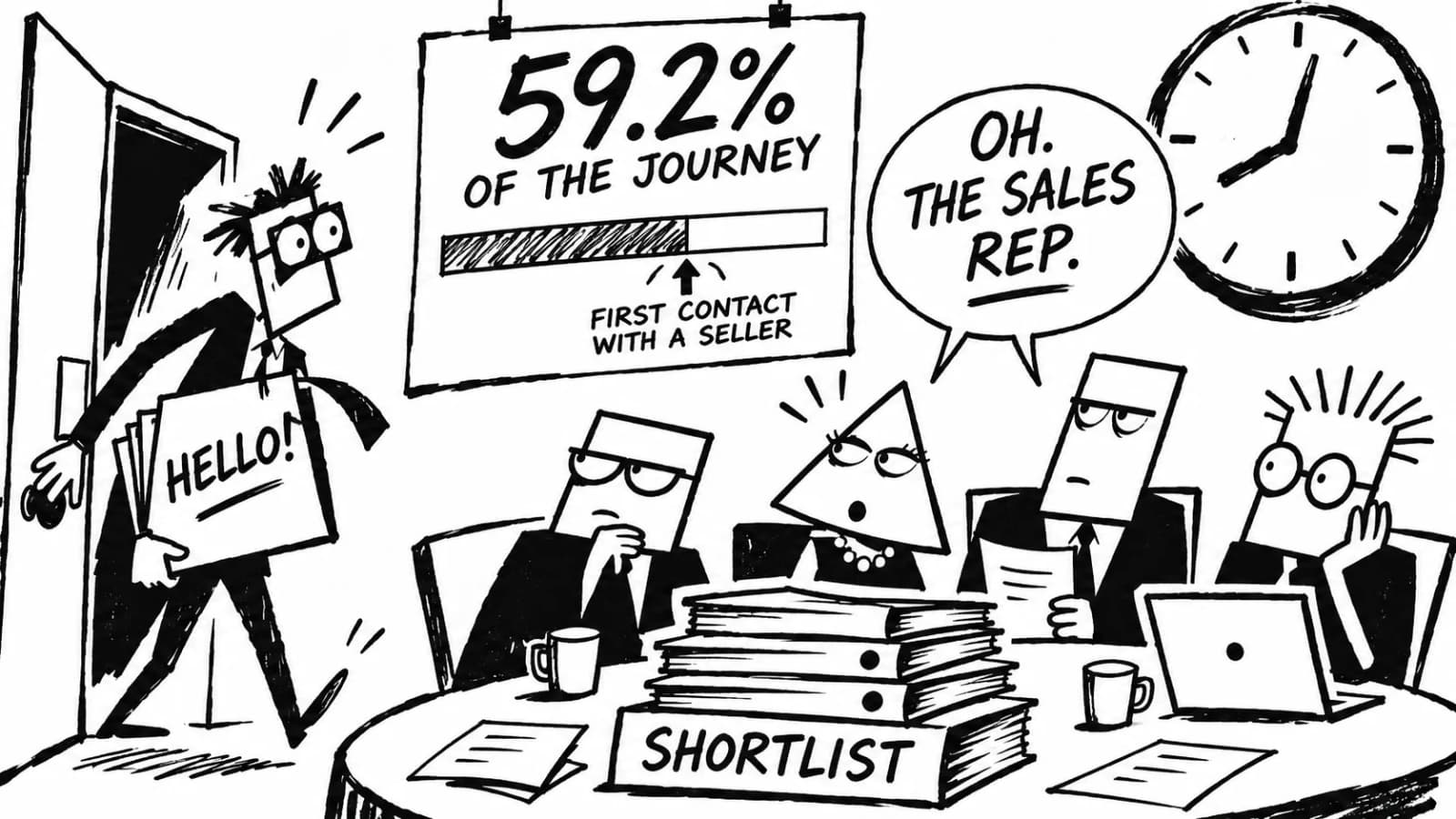
By the first sales conversation, buyers have completed an average 59.2% of a 10.3-month purchasing journey. Original GO!GEO editorial illustration of a 6sense finding.
The shortlist is often taking shape before your sales team gets the chance to make its case.
The 6sense report describes an average 10.3-month completed B2B purchase journey. Buyers first contacted sellers, on average, after 59.2% of that journey. In 91.7% of completed purchases, the eventual winner was already on the initial shortlist.
That means a beautifully prepared sales presentation can arrive after the buyer has already formed a strong preference.
And the process doesn't begin when a purchase is formally announced. 96% of respondents said they kept informed about relevant solution categories between active evaluations. The most frequently cited channel for doing so was vendor websites (35.9%). The report also found that 94% entered their current cycle with existing perceptions of vendors.
Your website is speaking to future customers before they are ready to buy. What they learn today can influence whether your company is considered months later.
That is why a B2B website needs to do more than confirm that a company exists. It should make the business value of each important service understandable, connect that service to credible experience, and give different decision-makers the evidence they need to evaluate it.
AI assistants are becoming part of what buyers already know
The 2026 report found that 81% of surveyed B2B buyers used large language models somewhere in their purchasing journey, with 26% using them to discover new suppliers. Another 25.2% said LLMs significantly influenced their perceptions of vendors.
And here is a particularly revealing comparison. During the supplier selection phase, AI assistants and vendor website content were each cited by 21.2% of buyers as influences on vendor preference. In the same question, buyers rated their existing knowledge at 34.4% and internal discussions at 31.8%.
21.2%
AI assistants / LLMs
21.2%
Vendor web content
Same survey question · Selection Phase · 6sense 2026, Table 12. These are influences cited by buyers, not algorithmic measurements.
But where does that existing knowledge come from? It accumulates through years of work, professional conversations, customer experiences, websites, reviews and increasingly interactions with AI assistants such as ChatGPT. Information first encountered in an AI answer can become part of a buyer's later understanding of a market or supplier.
That makes AI-assisted discovery commercially relevant well beyond the moment someone clicks an AI-generated link.
For an established B2B company, the question is increasingly practical: When a potential client asks ChatGPT or Google AI Mode to recommend three to five providers for a specific service, do your company's real strengths make it into that answer?
Can AI Assistants Connect Your Reputation to the Services B2B Buyers Need?
Many established companies already have the difficult part: years of expertise and a reputation earned through real work. But years of serving a market do not automatically put a business among the providers AI assistants recommend to buyers there.
In our experience, this is a recurring problem with established professional-services companies. Their websites may describe impressive projects, introduce experienced people and list awards. Yet the individual service pages often fail to connect those achievements to the particular service, buyer need and market that someone is researching. A prospective customer - and an AI assistant interpreting the site - may struggle to see why this otherwise credible company belongs on the shortlist.
At GO!GEO, we call the reputation and expertise a company has already earned its Existing Trust Advantage.
The opportunity is to make that trust easier for potential customers, search engines and AI systems to understand and verify.
Our original European consultancy research illustrates the issue.
An established EU funding consultancy founded in Slovenia has operated in Croatia since 2013. We tested how four AI assistants - ChatGPT, Claude, Gemini and Perplexity - answered realistic questions from businesses looking for EU funding consultancy support in eight European buyer situations.
In our October 2026 comparison, all four assistants named the consultancy for the Slovenia-focused question, concerning its home country. Yet the company was absent from all 28 answers to seven other European buyer situations, including Croatia. Looking specifically at Croatia across two testing dates and one additional Google AI Mode check, it appeared in none of nine recorded answers.
The company had genuine experience outside its home country. The AI recommendations did not consistently reflect that experience for those buyers.
A real track record is valuable. But a potential buyer still needs to encounter it at the moment they are choosing providers.
Our next task in a situation like this is to investigate how the company explains its services in the relevant markets, how its completed projects support those services, which specialists were responsible for the work and which independent sources verify the experience. We then turn those findings into improvements to the website and wider digital presence, and measure what changes after implementation.
This is Generative Engine Optimization (GEO) as practical business work: identify an opportunity, develop and implement a strategy, and measure the results.
A Common Weakness in Otherwise Professional B2B Websites
A website should help buyers make both decisions: whether to invest in the service, and whether to choose this provider. Yet a common weakness persists in otherwise professional B2B websites: the company page lists achievements, the team page lists job titles and the service page lists what the business sells. The evidence that connects those three pages is often missing.
A strong service page should answer the questions a real buying group needs to settle:
| The buyer's question | What your service page should show |
|---|---|
| Why buy this service? | A recognisable business problem, the opportunity it creates and an explanation of the expected commercial value. |
| Why this company? | Relevant projects, verified results, credible reputation and clear service-market fit. |
| Who will deliver it? | The responsible specialists, their relevant experience and what they actually contributed to similar work. |
| How can we justify the investment? | The approach, scope, indicative timing or pricing where appropriate, practical milestones and ways to evaluate outcomes. |
| What should we do next? | A clear contact route and a useful first step. |
A cybersecurity firm saying it offers “innovative end-to-end solutions” leaves buyers guessing. Describing the specific risks it handles, the experience of its consultants, relevant results and the work involved helps the buyer assess a real purchase.
This approach also aligns with Google Search Central's guidance on helpful, people-first content: provide original and useful information, demonstrate relevant first-hand expertise, explain who created the content and give people good reasons to trust it. Applied to a B2B service page, that means connecting genuine expertise and evidence to the service the visitor is actually evaluating.
The same clear information that helps buyers make confident decisions also helps AI systems understand a company's services, expertise and relevance.
A five-minute test for your most important service
Ask a colleague who doesn't already know your offer to read its page. Can they explain why a buyer should invest, why your company is qualified, and what result the engagement aims to produce?
Now test what AI assistants can find. To reduce personalisation, start a fresh conversation in a private or incognito browser session, signed out where possible, with saved memory and personalisation turned off. Do not give the assistant your company name or website. Ask ChatGPT, Google AI Mode and other relevant assistants to recommend three to five providers for a realistic, unbranded buyer question, specifying the service, buyer needs and target market. Record the question, date, recommended suppliers and evidence shown in the answers.
You are looking for a genuine buyer situation - not a prompt that tells the assistant which company you want it to recommend.
If you want an initial external perspective, GO!GEO's Free AI Visibility Audit investigates one priority service and realistic buyer questions to identify commercially relevant gaps and a possible next step.
A lost opportunity isn't always a win for a competitor
The new 6sense report examines 1,011 evaluations that ended without a purchase, alongside 3,596 completed purchases. Of those who did not buy, 64.4% found category justification harder than vendor selection, compared with 53.1% among buyers who completed a purchase. And 78% of buyers in the no-decision group expected to revisit the purchase within twelve months.
A stalled decision may therefore call for a better explanation of the investment rather than another aggressive sales follow-up. The provider that helps a buying group understand what it could gain, how to evaluate the work and what makes a provider credible may be in a stronger position when the decision returns.
Research scope matters: these were substantial B2B purchasing journeys, with a minimum annual purchase value of $25,000. The largest single purchasing-value group (41%) was $101,000–$500,000 annually. A smaller owner-led service purchase may follow a shorter path; the study's exact cycle length should not be assumed for every contract.
What Generative Engine Optimization (GEO) Can Change for B2B Service Providers
For an established professional-services business, GEO is an opportunity to build a new, measurable source of qualified enquiries from buyers who discover and evaluate suppliers through AI assistants.
At GO!GEO, we start with the company's growth priorities: which specific services, customers and markets could create the greatest commercial value, and where the business has the expertise and capacity to deliver. Then we examine the questions those buyers might ask AI assistants, which providers are recommended today, and what evidence supports the answers.
That research shapes a focused GEO strategy: a GEO-optimized website, clearer service descriptions, expert-led content, technically sound information architecture, and credible independent proof of the company's reputation beyond its own website. We implement the agreed work, measure what changes and use those findings to decide what to improve next.
Our operating cycle is hypothesis → test → measure → decide → next hypothesis.
Building an emerging acquisition channel is a strategic growth investment. Its timing and commercial returns are not automatic. For a high-value B2B service, however, a relatively small number of suitable new customers may be enough to make the investment meaningful. That is why the starting point is the economics of qualified demand - not a promise of more AI mentions.
The result we work toward isn't simply appearing in an AI answer. It's becoming a credible choice for the right buyer, earning a qualified enquiry and opening the possibility of a new client relationship.
Research and sources: 6sense, B2B Buyer Experience Report 2026, published 2 November 2026 (particularly Tables 2, 6–8 and 12); Google Search Central, Creating Helpful, Reliable, People-First Content. Original GO!GEO AI supplier-recommendation research, September–October 2026, covering eight European buyer situations: the full research report (PDF). The 6sense results and GO!GEO's research and strategic interpretation are distinct sources of evidence.
Cite this article
Andrej Slabinsky (2026). "Every B2B Service Provider Must Win Two Sales in 2027. Is Your Website Ready for Both?". GO!GEO. https://gogeoagency.com/insights/two-sales-b2b-service-providers-2027. Published 4 Nov 2026.
See what AI says about your company
Find out how leading AI assistants answer the questions your buyers ask about a business like yours.